MiKetz & The Secret of the Son, Part 1: “Swallowed Up” in Ego Death
MiKetz is a stunning Torah portion– as all of them irrefutably are– that reveals the awe-inspiring moment when Yosef HaTzaddik ascends from the humbling descent into the prison to the heights of authority to become, literally, a “Father” to Pharoah himself. Beginning with the interpretation of a dream– which, the Zohar reveals “come from the side of Nukvah”-- and culminating in Yosef’s brothers falling on their faces at his feet as he ominously tests them over the staged theft of a cup of divination, this portion delineates the uniquely feminine power of that which is hidden in the subconscious, veiled behind masks, and cloaked under the subterfuge that leads to salvation.
Mi-Ketz is usually translated as “at the end” referring to the end of exactly 2 years of Yosef’s imprisonment between the time of the Royal Cup-bearer’s release and reinstatement until he finally mentions Yosef to Pharaoh who seeks an interpretation of his dream. However, Mi-Kets can more accurately be understood as “from the end,” “because of the end,” or “out of the end.” Rabbi Shimon Bar Yochai in Sefer HaZohar on Parshat MiKetz tells us MiKetz is the end of the Left side of Gevurah (Dinim, harsh judgements and restriction), and the boundary of the Klippot. Rashbi continues to describe the mirroring of the Nukvah of Zeir Anpin (also varyingly known as HaKadosh BaruchHu, Tiferet, and Israel/Yaacob), and the Nukvah of the Klipah: As Above, So Below. Indeed, the Zohar also describes MiKetz as being the end of remembrance– as Yosef asked the Chief Butler to remember him and, although having been seemingly forgotten for a time, he was indeed remembered in the end, at the moment of Divine Alignment with Destiny. Yosef’s time in prison was an alchemical crucible of dinim where he descends after being humbled by relentless tests of temptation and devastated by the accusation of rape & adultery with Potiphar’s wife (his own seed spilled from between his fingers becoming entities that accused him). Transformed by the harsh judgements that constricted and restricted him, he was indeed enclosed in the womb-like hole of prison– the Nukvah of Klippot. Even in modern everyday euphemism, when one goes to jail/prison, they often say they went “to the hole” or were “in the hole.”

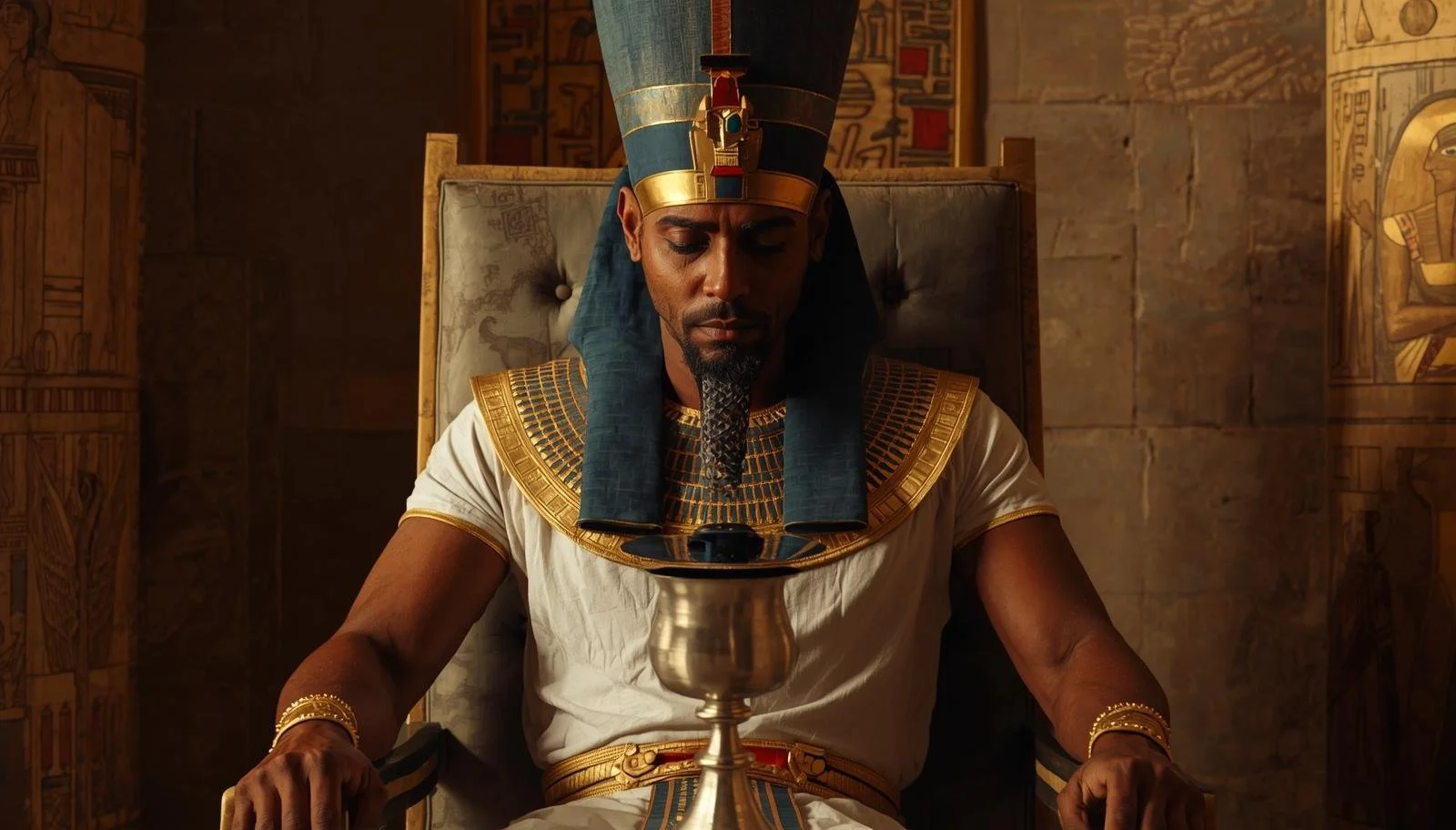
A time of being stripped of titles and all sense of identity, a season of purification by ego renunciation, we see even in this place of Gevurot there is still Chesed– although innocent, for having been accused of crimes that require punishment by death (rape and adultery), to be imprisoned is itself a merciful alternative sentence. Furthermore, even in the prison, he was granted a position of authority and leadership, given rulership (Malkhut) even in this space (Challal). Interestingly, the parallel between Pharaoh and Yosef (who himself is the embodiment of Sefira Yesod) is an intriguing juxtaposition and eventual transposition of Two Heads of Authority: one Above and one Below. Above, on the throne of Egypt, which ruled all of the known world at that time in history, sits Pharoah; Below, in prison, Yosef ruled. Yet, in a beautiful transposition, Yosef arises to elevated leadership and becomes a Father to Pharoah as a Master is regarded as the Father to their Student: embodying Torah, Yosef taught Pharoah Torah through his display of integrity, character refinement, and supernatural wisdom. As our Sages have always known, one who teaches Torah is as a Father to those who study under them.
In modern language, we euphemistically refer to a man’s literal physical Yesod as “the little head,” and, indeed, a man of unrefined character who allows himself foolishly to be led by lust and carnality, is said to be ruled or governed by his little head. In the 1990s classic Robert DeNiro film A Bronx Tale, DeNiro plays a father who tells his son “sometimes you gotta think with the Big Head and don’t let the Little Head tell you what to do.” The Yesod represents a channel of Ohr Ain Sof, a portal of Creation that can be the Foundation of Righteousness and, indeed, transmit the flow of Shefa (Abundance) as Zera (Seed) that multiplies the Light of Atzilut– either as physical children or as Torah Alef Consciousness. However, if unrectified, uncircumcised (metaphorically/spiritually as much as physically), the Yesod– which is most vulnerable to Klippot, according to Ari HaKadosh– can be a weapon of violence, a portal of destruction, and a transmission of impurity. When the consciousness ascends from the level of Yesod to the level of Chokhmah and, further, to Keter, then a King can truly be crowned– but only after first descending through the ego death to– and into– the Nukvah, the Malkhut, the darkness (Chosheck) of the Sacred Feminine, the dimension of humbling, devoured, as one is devoured by a Mouth. Remember, the gematria of Peh is the same as Yesod: thus, Mouth and Yesod are both portals between worlds, portals that create worlds. Indeed, Ari HaKadosh, in Shaar Ma’amrei Razal delights us with the tantalising code: the deep secret of woman as the creature with Two Mouths. The woman’s Yesod, a secret world enclosed, is the mirror of the mouth– and science proves that the lips, palate, throat, and vocal chords are a literal duplicate of the vaginal labia, canal, perineal floor, and cervix! The Yesod of woman is both womb and tomb– a tomb where a man’s ego dies and womb from which he is reborn, pure.
It is often by a woman that a man is humbled– we see this with Yaacob, humbled by the deception of Laban having served 7 years for a wife only to have her be substituted by her sister and being asked to labor another 7 years; we see this with Judah, humbled by Tamar literally embodying the duality of the Zona & the veiled Kadeshet of the Temple; we see it with Yosef, tempted by Potiphar’s alluring wife. Physically, a man, as Zakar and Yashar (upright, erect) must invert his upward trajectory to literally go down into the portal of femininity (Igul); physiologically, a man is humbled when his strength wanes inside a woman, his seed having emanated as he becomes soft and small; psychologically, man is often humbled by a woman as the pursuit of a woman inspires him to meet many challenges and stresses to acquire her, whether financially or otherwise; and spiritually, it is most often through a woman that a man must confront his Yetzer Hara. To Freud is attributed the concept of the “Vagina Dentata,” which literally translates to “vagina with teeth.” This concept, to Freud, explains man’s innate and inherent, unshakeable subconscious fear of losing his identity, renouncing his ego and individuality, as he merges with (and dissolves within) woman– in Yichud, 2 become 1, Echad. Indeed, a man seems to truly disappear in the hidden space (Challal) of a woman during Union, as, likewise, a growing baby is hidden, face unseen, in the body of its mother. Star Trek, an American television series about interdimensional space travel, coined the phrase “bravely go where no man has gone before”: indeed, within a wife, like Outer Space, man, like rockets, traverses a hidden realm undiscovered. Bravely transcending fear to go outside of one’s comfort zone, outside of what is familiar, is another intriguing interpretation of Mi-Ketz: out from the boundary, beyond the boundary, transcending fear through the humbling death of the ego and its illusions of separation to find unity.
….To Be Continued…
Original Intellectual Property Written by Chauah Hadassha Hadara 29 December 2025, at 5:45pm est