Events & Press Release
Detailed Report on the Historic Conference of the Chief Rabbinate of Africa: A Timeless Event
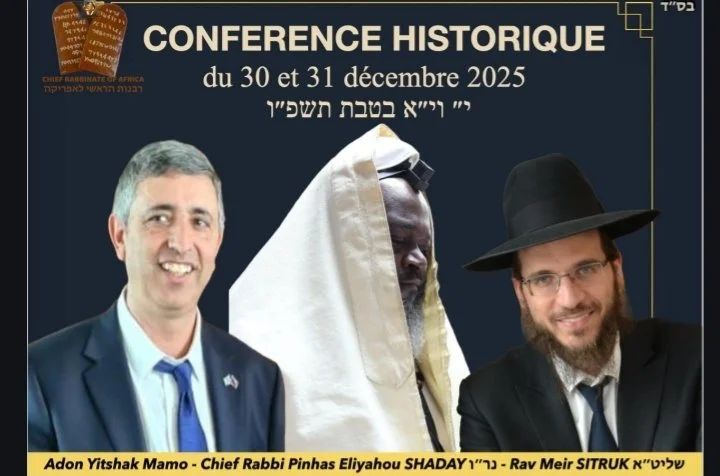
It is our great honor and pleasure to share the fruits of our righteous endeavor to organise, by invitation from the Ashkenazi community, the Historic Conference of December 30 and 31, 2025. This unprecedented event was of an exceptional scope that was an embodiment in real time of Parshat Vayigash: a monumental moment in which, face to face with Yehuda (Yehudim), the Bnei Yosef as the Ten Tribes were self-legitimised and self-actualised, collectively embodying the aspirations of the Grand Rabbinate of Africa and the unity of the Jewish people.
The conference held on December 30 and 31, 2025, marked a historic and symbolic moment for the Chief Rabbinate of Africa, the Bantu Israelite communities, as well as for the religious, institutional, and political authorities of Israel. This gathering laid a solid foundation for the recognition, empowerment, and spiritual, social, and political autonomy of the Bantu Israelites, descendants of the Ten Lost Tribes of Israel. This conference was a special time of reflection and frank, respectful and uncomplicated exchange, with the exceptional participation of two iconic figures: Rabbi Pinhas Eliyahou SHADAY (Le Gran Rabbi/Chief Rabbi of Africa, elected by the Bantou Israeli communities of Africa and the Diaspora). His presence was a powerful epitomisation and incarnation of the desire to think and build on this first encounter between the validation, through high level Torah Wisdom, of the oft-obscured history of the Bantou Israelites, in respect of their journey. As the event itself was an answer by the Bantou Israelite collective represented by Chief Rabbi Pinchas and the Chief Rabbinate of Africa to the request of the Ashkenazi community, thus, his formidable Presence was essential for building authentic connections. M. Yitshak Mamo, from the World Zionist Organization, World Leader of Orthodox Communities and Synagogues. His vision and experience was crucial in anchoring this discussion into reality and unity perspectives, representing the State of Israel.
Opening and Acknowledgments - The Chief Rabbi of Africa opened the conference by expressing deep gratitude to all participants, whether physically present or united in spirit. He emphasized the significance of this first formal and structured meeting between the Chief Rabbinate of Africa and the Bantu Israelite question, describing it as a true breakthrough in history, comparable to the biblical reunion of Judah and Joseph.
Historical Context and Identity Challenges - The Chief Rabbi recalled the profound and multiple sufferings endured by the Bantu peoples over the centuries: raids, slavery, colonization, forced conversions, and above all, the systematic erasure of their Israelite memory. He denounced the caricaturing and devaluation of their traditions, which for too long were dismissed as superstitions or ignored altogether. In response to this reality, the conference reaffirmed the determination to reclaim the narrative of their identity—not in a confrontational spirit, but with a commitment to honor the Torah and Jewish tradition in all its depth, rigor, and excellence.
Major Achievements Secured - The conference achieved concrete and historic progress with the Haredi Orthodox world and the State of Israel, notably: Institutional Trust. The credibility and excellence of the halakhic procedures of the Chief Rabbinate of Africa were recognized, strengthening trust in this institution as the legitimate spiritual authority for the Bantu Israelites: Freedom of Rabbinic Decree The freedom to apply religious decrees according to the specific criteria of the Bantu tradition was accepted, with explicit recognition of particular practices such as lunar Shabbat observance, conversion, Mishna interpretations, and other unique halakhic customs: Religious, Social, and Political Autonomy. The right to self-determination on their lands was acknowledged, based on the historical admission of the existence of an Israelite kingdom extended to the Ten Tribes and Moses, of which the Bantu are the spiritual and physical heirs. This recognition paves the way for respectful and responsible autonomy.
Rigorous Halakhic Approach - Relying on a psak (halakhic ruling) by Rav Haïm Kanievski, the Chief Rabbinate of Africa recognized the necessity of a “precautionary” reconnection (guérout le’houmra) to dispel any doubt regarding the Jewish identity of the Bantu peoples. This rigorous and respectful approach aims to fully integrate the Bantu into klal Israel while adhering to orthodox halakhic tradition. The Chief Rabbinate has thus developed an adapted halakhic framework, including specific protocols, a survey of living traditions, and the structuring of a “Noussah Afriki,” an African path of Torah faithful to the masters of the Mishna, Talmud, and Mekubalim.
The Federation of Jews of Africa: An Established Pillar - Founded in 2023, the Federation of Jews of Africa now unites 120 Bantu Israelite and Jewish associations across multiple countries. It plays a major role in the autonomous management of cases related to the status of Bantu Israelites. The African rabbinic committee, chaired by the Chief Rabbi, will diligently review each case, organize necessary conversions, set community standards, and ensure halakhic and social coherence. This structure reflects the maturity and responsibility of the Bantu Israelites, who no longer delegate the definition of their identity to external bodies but assert themselves as a legitimate and mature actor within klal Israel.
Call for Unity and Mutual Recognition - The Chief Rabbi concluded the conference with a passionate call for the unity of Israel, reminding that the Bantu Israelites do not seek to take anything away from the global Jewish community but to offer their loyalty, traditions, light, and resilience. He expressed hope for a future when all tribes, from Africa and beyond, will stand together in a song of unity and peace, fully embodying the promise of a united and diverse Israel.
Next Steps - A detailed report and a video montage of the conference will be published in the coming days to allow everyone to follow these historic developments. Additionally, a major conference on African soil is planned in the coming months, Be’Ezerat HaShem. Through this event, we were able to speak with wisdom and compassion to: - Deepen our understanding of the historical and spiritual links (Torah) that unite us. - Participate actively in building a common future that respects everyone's aspirations. - Strengthen our identity and connection to the Source. What transpired was, and remains, a sacred bridge (spiritual, religious, familial), pure and genuine, recreated between the Bantous Israelites (direct descendants of the 10 Tribes) and Israel. We lovingly share the words of Chief Rabbi Pinchas from that day in the documents below, making accessible the poignant words of the Chief Rabbi of Africa in English, French, and Hebrew:
U.N. Declares Transatlantic Slave Trade Biggest Crime Against Humanity as U.S., Israel Vote Against
A CRY FROM THE HEART AND THE PROFOUND ASTONISHMENT OF THE GREAT RABBINATE OF AFRICA FOLLOWING THE STATE OF ISRAEL’S VOTE AT THE UN REGARDING THE RECOGNITION OF SLAVERY AS AN ABSOLUTE CRIME AGAINST HUMANITY.
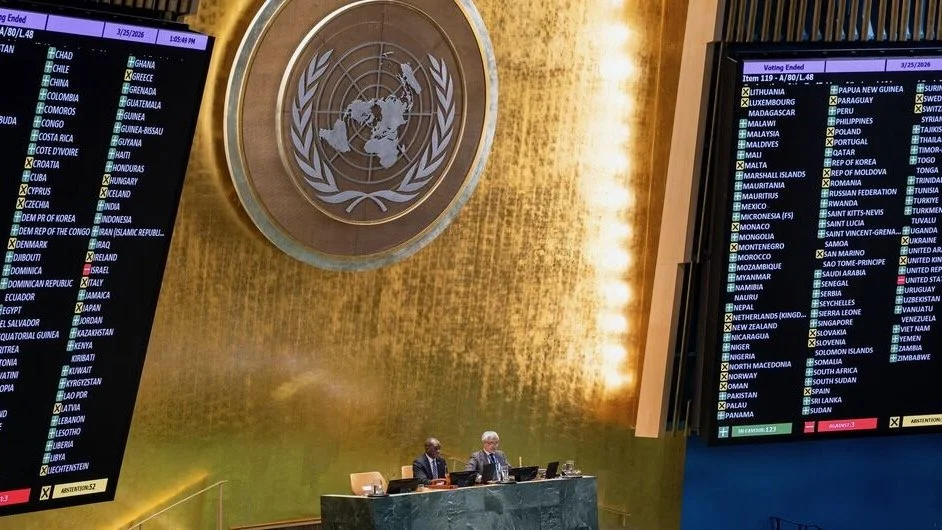
Paris, March 26, 2026 — It is with unspeakable pain and an incomprehension that shakes our very foundations that the Chief Rabbinate of Africa has learned of the United Nations General Assembly’s vote regarding Resolution A/80/L.48. While 123 nations chose the light of truth by recognizing the enslavement of Africans during the transatlantic slave trade as "the gravest crime against humanity," the State of Israel joined a triumvirate of refusal, standing in direct opposition to this historic recognition.
A Legacy of Blood and Memory
As the Chief Rabbi of Africa, heir to a land that still bears the scars of the transatlantic trade, I salute the prophetic courage of Ghana, President John Mahama, and Minister Samuel Okudzeto Ablakwa. This vote was not a vain competition of memories, but an elementary act of justice for the 15 million souls torn from their dignity, their land, and their lives. For years, our Rabbinate has worked tirelessly to restore a truth that time sought to erase: the natural, legitimate, and historical place of Black people within the Israelite spiritual family. We teach that African identity and Israelite spirituality are bound by a covenant of resilience in the face of oppression. This negative vote strikes at the very heart of the brotherhood we are building through faith.
The Violation of the "Zakhor" Imperative: How can the State that claims to carry the banner of the People of the Book—a people who have made "Zakhor" (Remember) a divine and immutable commandment—now deny the singularity of the crime of slavery? How can those who have known extermination refuse to recognize the ordeal of their African brothers, whether Israelite or not? This refusal of memorial solidarity is an open wound for all the sons and daughters of Israel on the African continent and in the territories of their exile. It is a moral contradiction that offends the universal conscience and betrays the very spirit of our Prophets and our Sages.
A Solemn Appeal and a Demand for Truth: The Chief Rabbinate of Africa calls upon the Ministry of Foreign Affairs of Israel, as well as the highest religious authorities in Jerusalem, with the gravity that this hour demands. We demand an official, clear, and public explanation regarding the motivations behind this "No" vote—a position even more radical than that of the former colonial powers, who chose to abstain. We call upon diplomats to explain how this decision can be reconciled with "Tzedek" (Justice), the unshakeable pillar of the Torah. Reparatory justice is a matter of human dignity and spiritual truth. We cannot, and we will not, accept that the agony of our ancestors be minimized by those we call our brothers. Silence and indifference are no longer options. The truth must be spoken, and justice must be served.