
The Power of the Tu B’Shevat Seder, Part One: The Moon and her Fruits
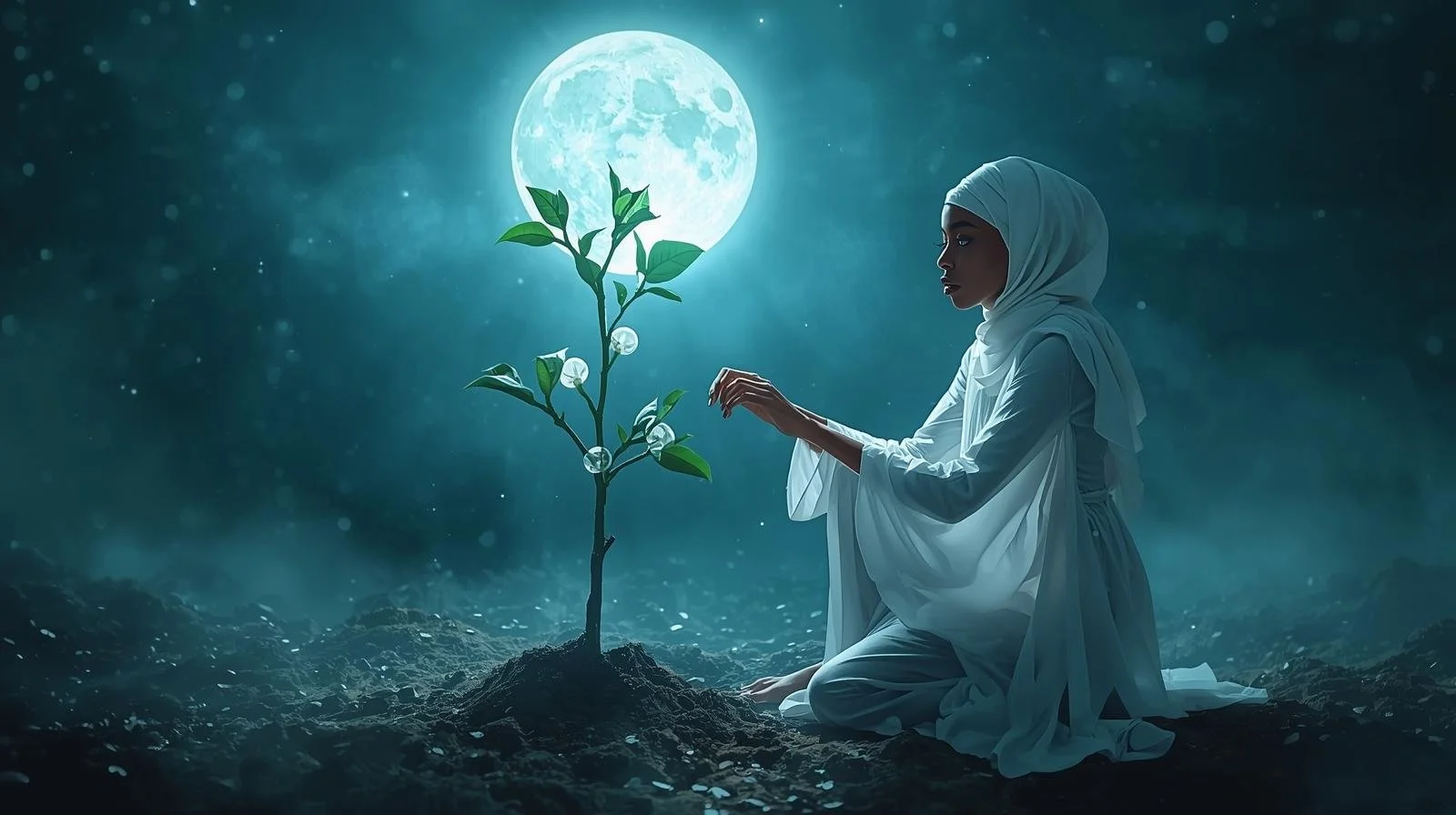
The secret of Tu b’Shevat is not merely about the New Year of the trees, it is about rectification through observance of Shabbat Shel HaTannaim (otherwise known as The Lunar Shabbat) and the secret of the lunar cycle and its powerful feminine influence. Our unraveling of these profound mysteries begins with Rabbi Nehuniah ben haKane, student of Rabbi Yochanan ben Zakai and Rabbi of Rabbi Akiba and Rabbi Ishmael Kohen Gadol.
In halacha elucidated in Sefer HaKane, he begins writing about Pesach concerning Bedikat Chametz. He delineates the first day of Pesach as Shabbat, the day of the Full Moon of 15 Nissan.
“And we call a day Chodesh….” as is written
It is only written Chodesh beside a “day” that is Shabbat. He explains thus: if it is Shabbat, why on Yom Tov are we allowed to cook? On normal Shabbat days, 39 Malachot are forbidden, yet on a Yom Tov one of the 39 is permitted– cooking. The question itself reveals the answer. Yamim Tovim are the Holy Festivals of Pesach, Shavuot, Sukkot/Shemini Atzeret, and Rosh Hashanah. By Rabbi Nehuniah ben HaKane posing the question of why we are allowed to cook on a Yom Tov, the direct implication is that these Festivals are Shabbatot because on all days of our calender, we cook everyday except Shabbat. Therefore, the very fact that it is made exceptional to cook on a Yom Tov indicates these are not mundane days and are, in fact, Shabbat days. Indeed, these Yamim Tovim are special Shabbat days in which one of the 39 melachot is permitted– cooking– for the purpose of Ohel Nefesh, feeding the soul.
Many believe the difference between a Shabbat and a Yom Tov is that a Festival is a special occasion marking a historical event. In fact, the sole distinction is that a Yom Tov is a special Shabbat in which we are allowed to cook because Shabbat itself is a historical commemoration also, like the Feasts, which we memorisalise every 7 days.
Just in case anyone was thinking Rabbi Nehuniah ben HaKane was too far into the Sod, we have a second witness in the widely respected Rashi, whose first statement concerns why the Torah starts with Bereshit when he feels it should begin directly with the observance of the moon as marking the beginning of the month, an ever-present, unchanging celestial marker by which we define the count of Shabbat. A simple, eternal, heavenly calender: from the beginning of months, which is the first sighting of the moon, we define every 7 days henceforth as a Shabbat. All the beginnings of months and all of the Festivals and countings of the years (Shabbaticals and Yovelim/Jubilee years) are defined based on the count of the moon. Thus, the first day of Pesach will always be a Full Moon and will always be Shabbat.
For a more logical elucidation, we look to the Mishnah, of which there are 6 orders: Zeraim, dealing with agriculture; Moed, concerning Holy Days and their associated practices; Nashim, regarding family law; Nezekim, delineating arbitration concerning damages; Kodeshim, describing sacrifices and offerings; and Taharot, defining dimensions of purity. In Moedim, the very first tractate is Shabbat– in which the Holy Days are defined according to the moon cycle. Thus, its inclusion shows Shabbat, like all Moedim, is defined by the moon phases, just as Pesach, Shavuot, Rosh Hashanah, Sukkot, Purim, and Hannoukah.
In Mishnah Rosh Hashanah, we discover there are 4 New Years:
1 Nissan– the New Year of Kings
1 Elul– the New Year of Animal tithes
1 Tishrei– the New Year of the counting of years for planting, Yovelim/Jubilees, and Shabbatical years
1 Shevat– the New Year of the trees
Why, then, is Tu B’Shevat celebrated by mainstream Judaism on the 15th of Shevat?
We immerse ourselves, then, in the nuances of the makloket between Beit Shammai and Beit Hillel. We note, with reverence, that different opinions as preserved in our Oral Torah are never opposing contraditions– rather, we always resepct 2 opinions as unique facets of perspective revealing different dimensions of revelation (PaRDeS) which are both true. Thus, we who uphold the Nusach of the Authentic Mekubalim, the Nusach Afriki, we observe this New Year of the Trees on both days, because Beit Shammai’s opinion always reflects the inner Sod dimension, and Hillel the more mainstream, Pshat dimension.
Although we refer to this moment of the year as the New Year of the trees, many other cultures, including, most notably, the Chinese, regard this time as the Lunar New Year. So why do we specifically make this distinction? For this answer, we look to the Torah, in Debarim, Parshat Shoftim, in Chapter 20, verse 19:
כִּֽי־תָצ֣וּר אֶל־עִיר֩ יָמִ֨ים רַבִּ֜ים לְֽהִלָּחֵ֧ם עָלֶ֣יהָ לְתׇפְשָׂ֗הּ לֹֽא־תַשְׁחִ֤ית אֶת־עֵצָהּ֙ לִנְדֹּ֤חַ עָלָיו֙ גַּרְזֶ֔ן כִּ֚י מִמֶּ֣נּוּ תֹאכֵ֔ל וְאֹת֖וֹ לֹ֣א תִכְרֹ֑ת כִּ֤י הָֽאָדָם֙ עֵ֣ץ הַשָּׂדֶ֔ה לָבֹ֥א מִפָּנֶ֖יךָ בַּמָּצֽוֹר׃
This verse concerns war– how do we connect this pasuk with trees?
Commonly translated: “is the tree of the field man?” in Hebrew it states:
Ki Adam etz ha-sadeh…
“Because the man is the tree of the field” b’sod Betzalel.
This New Year is named after the trees because the moon (not sun) is the only thing that can influence the man (fertility, libido, emotions, birth cycles, even the growth of plants whose seeds are sown by man– or woman). This is because the moon is connected to the feminine dimension of darkness (חֹשֶׁךְ Chosheck), the Night (לַיְלָה Layla, the Mystery Code of the Name of Ba”N), and the Hidden nature of the Secret (סוֹד Sod). Indeed, femininity, it is well understood, is the dimension of magnetism and the element of water– hence the moon’s influence on the ocean’s tides as well as the emotions, psychology, and hormonal ecology of mankind. This aspect of man, connected to this dimension, when not righteously handled, causes man to not only create destruction (war), but become destruction. When it is light and everyone can see one another, very few have the courage– or craziness- to openly challenge or incite disruption. However, at night, when all is quiet, the yetzer hara starts stirring, creating thoughts from the dimension of the moon– hence the etymological link between moon/Luna and lunatic or lunacy.
Thus, the Lunar New Year is the auspicious moment man can be most powerfully rectified.
How do we know?
In Ben Ish Chai’s introduction to Parshat Shemot, explaining the laws of Kiryat Shema and Amidah, he explains the secret of the 3 signs of Moshe, 3 wonders performed that would make his leadership indisputable by the people that may doubt by whom Moshe was sent. These 3 signs are:
The staff which turned into a serpent and back to a staff again
The hand that became white, then turned black again
The waters of Yaor (the Nile) turned to blood
What is the meaning? A hint lies in the shared etymological seeds of the words: לְאַשֵּׁשׁ la’ashish (to build/found or make firm) and שָׁרַשׁ sharash (to root). The wonders of Moshe were enacted to root the righteous faith in man and to root man in righteous faith, as the tree with its roots is the archetype of man.
Every sign has its meaning:
The snake and the staff– enacted to stop the heresy of duality, to purify the minds of those who believe in 2 equal powers of good and evil, two separate forces as God and the Devil
Hand in bosom– for those who believe good and bad is the same origin, but when it changes/transposes, they attribute the change to the work of the devil who changed one’s fortune, thus ascribing power to something other than the One True God, Our Limitless Creator Ain Sof
The blood of Yaor– for those who believe when they have good it is God but attribute misfortune to the devil or the influence of stars (Avodah Zera)
The purpose of the New Year of the moon is to use the sap that comes from the bottom to feed the roots to make our fath righteous in order to believe the right way.

Why/how is this connected to the moon? The dark side of the man is harder to handle: the man or woman who masters and sweetens the dark side becomes tzaddik yesod olam.
How do we know?
In the calendar, there are two periods:
Solstice– night and day unequal
Equinox– night and day equal
Winter solstice– night longer
Summer solstice– day longer
Fall/Autumn equinox– equal dark and light
Spring– equal light and dark
In the Zohar the moon said “it is not good to have 2 Kings”, from a logic rooted in Binah, from the side of gevurah, a separatist and hierarchical, mindset that is the origin of war due to the division this type of rationality necessitates, to structure understanding of what is by defining what it is not in relation to an other. In a realm of a differentiation of an “other” there is no unity as characterised by undifferentiated wisdom (Chokmah). Thus, at this plea, God diminished the moon and came to regret it, thus he begged Israel to bless the New Moon every month to rectify her.
What traps us in our dark side? The imbalance of masculine and feminine in most days of the year which leads to dominance, arrogance, duality, supremacy, and heresy. This is the mentality of 2 camps– duality and dualism. This is the mentality of the solstice, an illusion of polarity that leads to establishment of hierarchy, in which the illusion of high and low creates an automatic categorisation of things in terms of what is better or worse, good or bad, pure and impure, desirable and undesirable. This duality and the inequality of the days of solstice create various conditions: the days of summer create frivolity, laziness in study in favor of pleasurable pursuits, laxity, even promiscuity; winter creates stagnation, hibernation, slothfulness, and depression.
Equinoxes are only 7 days in the year: 3.5 days in spring, 3.5 days in Autumn. These days are the 7 days of the whole year in which dark and light are equal. In order to honor the2 equinoxes, we honor the 2 houses of Shammai and Hilel, to honor the days of unity as rectification of the heresy of divisive duality and polarity. Beit Shammai encourages us to observe the New Year of the Trees on the 1st of Shevat, the New Moon Shabbat, Rosh Chodesh. Observing this day, at this lunar phase, empowers the man from the sap in the roots as a way to honor the timeline of the First Equinox of Spring, ensuring renewal. Beit Hillel endorses the observance of Tu B’ Shevat on the Full Moon Shabbat, the 15th, where the moin at this phase empowers the sap in the middle of the tree to honor the Autumn Equinox. In Mishnah Rosh Hashanah, we observe the evening(s) of the 1st and 15th of Shevat with the Seder of the Mekubalim and the heritage of Rabbi Nehuniah ben HaKane.
From the Kitvei Ari, Shaar HaLikutim, Parshat Eikev, gives us the codes and correspondences to enhance our kavanot during the seder to root us firmly in our faith through the rising of the sap, in the strength that comes from our assurance that good and evil both come from One Source– our Limitless Ain Sof– and all is the Glory of Ain Sof, including the shifting Wheel of Fortune, the changing seasons, & the transposition of circumstances. Just as Dark and Light are of Ain Sof and are both Holy, so is wealth and poverty, promotion and demotion, birth and barrenness, high and low– everything in its season.
During this Seder, we eat 7 fruits representing the 7 balanced days as rectification of the 7 Kings whose deaths– Shevirat HaKelim– created tohu and whose rectification allows us to receive the 7 manifestations of Shefa (the Flow of Abundance). During Kabbalat Shabbat, we welcome Shabbat Malketa to our table adorned with these 7 fruits of Eretz Israel, lighting 4 candles for each moon phase and 7 candles for the days of the week as Nerot Shabbat, totalling 11 candles to represent the victory over the 11 klippot resulting from the imbalance and inequality that began with the diminishment of the moon which, HaZohar teaches us, is the origin of the manifestation of Shekinah in exile as Lilith, mother of klippot, despondent at her diminishing and separation. This moment of reconciliation, restoration, and rectification through reunification is made potent at this auspicious moment of honoring the renewal of the lunar cycle, the 7 fruits of Eretz Israel symbolising the fruits of the Challal which we know is Sadeh, Malkhut. Through this Seder we truly receive the Abundance of the Kingdom (Malchut) through rectifying the 7 kings, also representative of the 7 sefirot, the “fruits” or “children” of Challal and Kav in Yichud, as we energise this moment with kavanot of unifying Vav and Heh, Zeir Anpin and Nukvah.
The 7 Kings of Bereshit 36:31 are the roots of every Israelite soul and their fixing releases to every soul the 7 flows of Abundance associated with each sefirot as follows:
Wheat- Sefirah Chesed- King Bedad Ben Beor- Shefa of חַיִּים Chayyim (Life), embodied by Avraham Avinu- from the celestial influence of שַׁבְּתַי/Saturn
Barley- Sefirah Gevurah- King Yovav ben Zera- Shefa of שָׁלוֹם Shalom (Peace), embodied by Yitzhak Avinu- from the celestial infouence of צֶדֶק/Jupiter
Wine- Sefirah Tiferet- King Chusham of Teman- Shefa of חָכְמָה Chokmah (Wisdom), embodied by Yaacob Avinu- from the celestial influence of מַאֲדִים/Mars
Fig- Sefirah Netzach- King Adad ben Bedad- Shefa of חֵן Chen (Grace), embodied by Moshe Rabbeinu- from the celestial influence of חַמָּה/Sun
Pomegranate- Sefirah Hod- King Semleh of Masrecka- Shefa of עָשַׁר Osher (Wealth), embodied by Aaron Kohen Gadol– from the celestial influence of נֹגַהּ/Venus
Olives (or olive oil)- Sefirah Yesod- King Shaul of Rechovot- Shefa of זֶרַע Zera (Fertility), embodied by Yosef HaTzaddik- from the celestial influence of כּוֹכָב/Star
Dates (or date honey)- Sefirah Malkhut- King Baal Chaman ben Akbot- Shefa of ממשלה Memshela (Governance/Authority), embodied by David HaMelech- from the celestial influence of לְבָנָה/Moon
During the seder of the Authentic MeKubalim, one must also eat a portion of each fruit while silently intending (not speaking aloud) one of the 7 Names from the Ana BaKoach poem.

Thus the Tree is fixed, the Tree Etz Chaim which we associate with the structure of the Sefirot.
The Tree is also the code for the image of Man (Ha’Adam), planted by the waters, its roots fed by the waters alluded to in Petach Eliyahou. Our ancestors were always agricultural people, living in harmony with the land and nature– farmers, gardeners, herbalists– sowing seeds according to the phases of the moon– an act for which countless of our ancestral mothers were terrorised, demonised, and often murdered under accusations of witchcraft and sorcery. The ascending moon (waxing) of the days 1-14 of the lunar cycle exerts its magnetic and energising force on the vital forces activating the seeds sown during this time beginning to sprout into roots. The waning moon of days 15-28 of the lunar cycle favors the invigoration of the tree sap rising from the roots through the stems, vines, bulbs, and leaves.
Strong roots make temperance and fortifies one against the tides of changing times, shifting winds and seasons– keeping one strong against the dualistic mindset that breeds despair when day seems to turn into night, success seems to turn to stagnation, and spring’s exuberance turns to winter’s stillness. Temperance is Joy in all seasons, the gift of moderation, one’s contentedness in unity, the harmony that is the Beauty of Balance we call Tiferet. Tiferet, the middle pillar, embodied by Yaacob Avinu, is Zeir Anpin, HaKadosh Baruch Hu, and manifest as Adam HaRishon.
In Tikkunei Zohar, Tikkun 16, Rabbi Shimon Bar Yochai calls Challah B’Reishit”, imploring us to call Challah the “First Fruits” of the bread, not the Head (Rishon), but Reishit– the beginning. Thus, as the Beginning, the First Fruits, the portion reserved for the Holiest elites, it is the dough that is separated from the Challah– not the other way around! This subtle nuance is critical, as we should not make the mistake in kavanah by seeing ourselves as removing challah as a diminutive portion separated from dough as an afterthought; instead we regard the Holiness of Challah as the Terumah Taharah, from which the rest of the dough is removed after the First Fruits (“Bereshit”) is sanctified for the Priesthood. Thus, Challah is the offering one should elevate: the secret of Adam HaRishon as “Bereshit”, the “first fruits” of the world, the Challah of the world offered up as the Choicest Portion.

Even here, however, there is an intriguing paradox: this offering was a sacrifice for sin, by which Adam was diminished 120 Amot (as Ari HaKadosh reveals through Rabbi Chaim Vital in Shaar HaPesukim), represented as the 120 years
וַיֹּ֣אמֶר יְהֹוָ֗ה לֹֽא־יָד֨וֹן רוּחִ֤י בָֽאָדָם֙ לְעֹלָ֔ם בְּשַׁגַּ֖ם ה֣וּא בָשָׂ֑ר וְהָי֣וּ יָמָ֔יו מֵאָ֥ה וְעֶשְׂרִ֖ים שָׁנָֽה׃
But for what sin was Adam offered up? The secret is in the very fruits of the Tu Be’Shevat seder.
Continue to Part 2 for more of the encodes embedded in the Tu Be’ Shevat Seder….
**Note: humbly I assert that these words are not my conjuring or intellectual craft, they are a summation of the words of my Master, Chief Rabbi Kitoko Pinchas Eliyahou Shaday, compiled from several of his electrifying limudim—elucidating the secrets revealed from the writings of our Sages mentioned throughout this article— two of which are linked below:
https://youtu.be/FbhrnIln94k?si=QD4v_YOjq7jdxHBh
https://www.youtube.com/live/kyyeUCH1oA8?si=nrzi1MIvnrb4wgSz
