
Superstition, Religion, and Wisdom: Moving from Fear to Knowledge
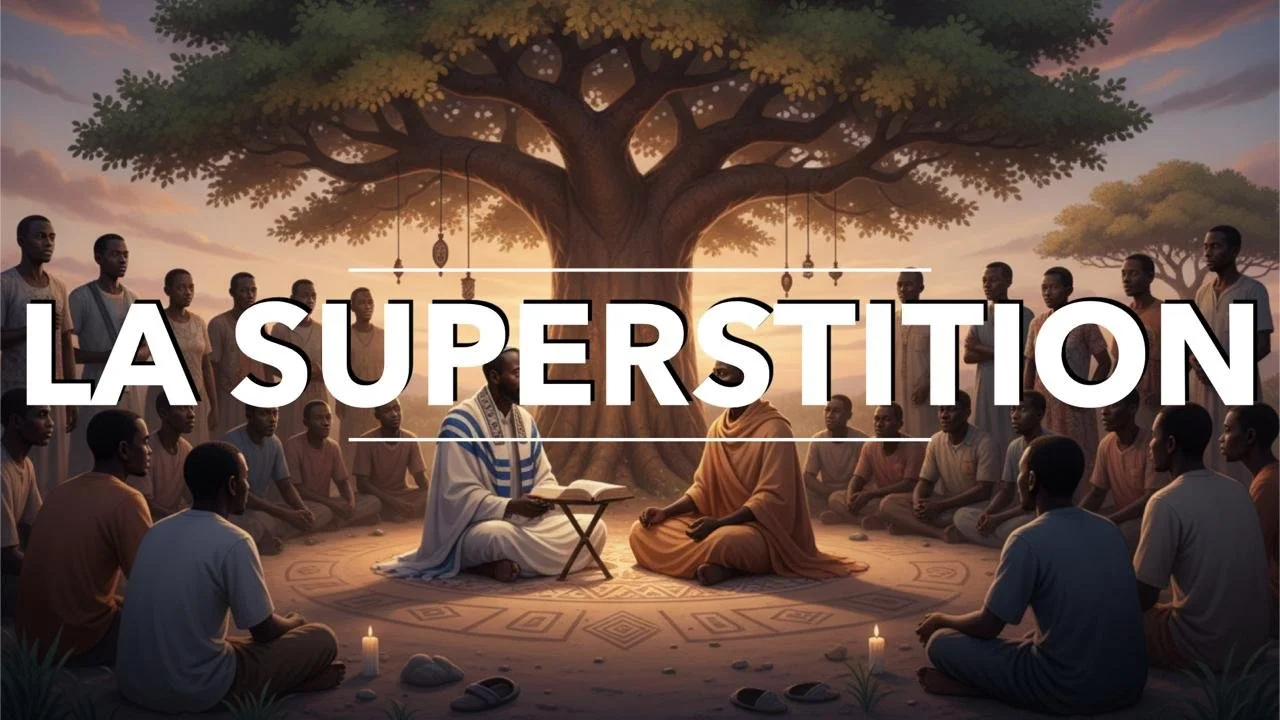
The think tank ALEF, through its discussion forum “Carrefour des sagesses,” (Crossroad of Wisdom) convened around the Chief Rabbi of Africa (Pinhas Eliyahou SHADAY) and several speakers to address a theme that may appear marginal, yet is central to social cohesion:
Starting from a deliberately broad definition—one is superstitious when one acts without understanding the causal logic of one’s action—superstition ceases to be a marginal phenomenon and becomes a lens through which to interpret both individual and collective behavior.
From this perspective, superstition is no longer reducible to “charms,” amulets, or often-caricatured village practices. It begins whenever a gesture, a statement, a vote, or ideological adherence is undertaken without any effort at understanding: one obeys, imitates, repeats, yet does not know why, nor how, this is supposed to have an effect.
The discussion shows that superstition permeates three major domains:
The religious sphere: when believers follow rituals, prohibitions, or prescriptions simply because “the rabbi / pastor / imam said so,” without studying their sources, spiritual rationale, or ethical implications. Faith then becomes dependency on another’s word rather than a search for truth.
The political sphere: when a citizen votes for a candidate or a platform without having read or analyzed it, relies on slogans or images, or circulates rumors without verification, the same mechanism is at work: the outsourcing of judgment to a figure of authority or to the flow of social networks, instead of making an informed choice.
The social sphere: when individuals reproduce family, community, or cultural norms with the sole justification that “this is how it has always been done,” without questioning their concrete effects on dignity, justice, or individual freedom.
In all these cases, what they share is not the specific content of the belief, but the abandonment of three core requirements:
Study – taking the time to examine texts, facts, and arguments.
Understanding – seeking the causes, coherence, and consequences of what one does.
Individual responsibility – accepting that no one can think, decide, or believe in our place.
Superstition thus appears less as a leftover of “pre‑modern” ignorance than as a permanent temptation: the temptation to free oneself from the burden of thinking, in favor of the comfort of merely following.
This analytical note highlights four major lessons that go far beyond the religious sphere alone and touch on how our societies conceive of and govern themselves.
1. Superstition as a Symptom of the Abdication of Personal Responsibility
Superstition is not merely a residue of ignorance or a relic of an earlier age. It becomes the sign of an inner renunciation: to give up examining, questioning, and understanding is to yield to the ease of allowing others to think in our place. This applies to the believer who is content simply to obey a spiritual leader, but equally to the citizen who follows a political slogan without scrutiny.
In societies that officially valorize autonomy and critical thinking, the persistence of superstitious behavior reveals a profound fragility of individual responsibility.
2. Study as the Central Lever for Overcoming Superstition
In light of this diagnosis, the note insists that the genuine alternative to superstition is neither cynicism nor ridicule of religion, but study. Studying texts, rituals, doctrines, political platforms means restoring to individuals the capacity to connect their faith, their choices, and their commitments to actual understanding.
Within religious traditions, this entails repositioning pedagogy, exegesis, and questioning at the very heart of spiritual life. In the civic sphere, it requires education in the analysis of discourse, facts, and sources—a minimal condition for an informed democracy.
3. Reconsidering African Traditions in Their Symbolic Depth
The note also calls for a reassessment of African traditions, which have too often been dismissed as “superstitions” or “fetishism” through a colonial gaze. Numerous ritual, calendrical, and symbolic systems in fact display a genuine architecture of meaning, at times in implicit dialogue with the major scriptural traditions (Torah, Gospel, Qur’an).
The point is not to elevate these traditions to absolute norms, but to acknowledge their anthropological and spiritual depth and to foster serious comparative work, rather than sweeping them aside with a dismissive gesture.
4. Building Shared Social Life on Knowledge Rather than Prejudice
Finally, the note underscores the urgency of constructing coexistence not on fear of the other, nor on a superficial tolerance, but on a genuine understanding of each group’s references, codes, and internal logic. This requires articulating three dimensions:
Intelligence, which analyzes and compares;
Wisdom, which transforms character and orients it toward the good;
Emotional self‑mastery, which prevents fear, anger, or jealousy from becoming political drivers.
A sustainable model of living together cannot rest on vague or caricatured representations of Jews, Muslims, Christians, Africans, secular citizens, and others. It demands an effort of mutual understanding, supported by educational and religious institutions that fully embrace their role as mediators between belief, knowledge, and society.
The note does not confine itself to theoretical observations: it leads to concrete recommendations tailored to different levels of responsibility.
It is addressed first to religious and educational institutions, calling on them to place study, pedagogy, and explanation back at the center of practice, in order to reduce the hold of superstitious reflexes within faith communities themselves.
It then targets public actors and African and diasporic civil societies, urging them to reassess their own traditions, move beyond patterns inherited from colonization, and articulate African heritage and scriptural references in a more lucid way.
Finally, it addresses political leaders and democratic institutions, emphasizing that the struggle against superstition—in its religious, media, or conspiratorial forms—is also a matter of public policy in education, information, and informed public debate.
1. Redefining Superstition: A Contemporary Challenge
1.1. From Naive Belief to Intellectual Abdication
In its most common sense, superstition refers to irrational beliefs in omens, signs, or magical practices: breaking a mirror is said to bring bad luck, a black cat is seen as a bad omen, a given object is thought to protect mechanically from harm.
The ALEF Think Tank proposes a more demanding and operational definition:
A person is superstitious when they carry out a practice without knowing its causal logic—“I was told, I believe, I do.”
This shift is decisive. It makes it possible:
to move superstition out of the purely folkloric register and inscribe it within that of individual responsibility: what is at stake is not only what one believes, but how one believes;
to identify the lack of study and questioning as the core of the problem, including among educated individuals who are otherwise capable of complex reasoning;
to enable a cross‑cutting diagnosis: one can be superstitious in a sanctuary, in a meeting room, on a television set, or in a voting booth, whenever one renounces questioning the meaning of one’s actions.
Superstition thus appears less as a naive belief than as a form of intellectual abdication—the implicit choice to allow others to construct, in our stead, the coherence of our actions and commitments.
1.2. Religious, Social, and Political Forms of Superstition
On this basis, the Think Tank extends the notion of superstition to behaviors that, at first glance, do not seem to belong to the realm of “magic”:
In the political sphere, voting for a platform one has neither read nor analyzed, relying on slogans or images, amounts to taking a decision with far‑reaching consequences on the basis of rumors, algorithms, or charismatic spokespersons.
In the religious sphere, adhering to a discourse or ritual solely because “the rabbi, pastor, or imam said so,” without seeking its source, context, or deeper meaning, reflects the same mechanism of total delegation of judgment.
In the social sphere, accepting family, community, or cultural norms solely on the grounds that “this is how we’ve always done it” amounts to neutralizing any inquiry into their concrete effects on justice, freedom, or human dignity.
Across these three domains, the underlying logic is identical: wherever individuals renounce examining, understanding, and assuming the implications of their choices, superstition ceases to be the exception and becomes “the silent norm,” structuring behavior.
Political Superstition: A Blind Spot of Democratic Life
Accepting a political project without reading its content, making up one’s mind on the basis of a slogan rather than a platform, circulating rumors without checking their origin, or relying on the word of “experts” without attempting to understand their assumptions—these behaviors follow the same logic as religious superstition.
In all such cases, the citizen renounces exercising their own judgment and delegates the task of thinking to others—political leaders, influencers, media commentators. This intellectual abdication undermines:
the quality of democratic debate, reduced to the clash of emotions and simplified narratives;
trust in institutions, perceived at times as quasi‑magical authorities, at other times as invisible enemies;
the collective capacity for discernment, that is, the very possibility of deciding together on the basis of facts, arguments, and acknowledged disagreements.
Political superstition thus emerges as a blind spot of contemporary democracies: it thrives not despite mass access to information, but precisely when such access is not accompanied by genuine critical education.

2. Study as an Antidote to Superstition
2.1. Studying as a Way Out of Fear
The Chief Rabbi underscores a decisive point: one does not overcome superstition by rejecting religion, but by engaging it through study. It is not the presence of faith that is problematic, but the absence of intellectual work applied to that faith.
As long as prescriptions are formulated in terms such as “do this and your life will change,” without explanation or contextualization, they function as magical injunctions. The believer obeys and hopes for an effect, but does not know why or how the act is supposed to work. The fear of “doing it wrong” then replaces the search for truth.
Once accompanied by study, these same prescriptions can change status. They become:
practices embedded in a history, connected to texts, events, and interpretive debates;
gestures that carry explicit symbolic meaning, articulating body, speech, and memory;
levers for personal and communal transformation, shaping how one relates to oneself, to others, and to the world.
Understood in this way, superstition appears less as an “excess of belief” than as a deficit of understanding: the issue is not believing as such, but believing without seeking to understand.
2.2. Rehabilitating Individual Spiritual Responsibility
From this perspective, the Chief Rabbi of Africa highlights an often‑overlooked issue: spiritual responsibility cannot be fully delegated. Entrusting one’s inner life to “religious professionals” alone—rabbis, priests, imams, pastors, marabouts—amounts to:
renouncing one’s dignity as a thinking subject, capable of examining, doubting, and questioning the religious discourses addressed to them;
exposing oneself to spiritual and financial manipulation, where promises of protection, healing, or prosperity are no longer framed by genuine pedagogy;
accepting a form of lasting infantilization, in which adults remain dependent on others’ opinions to know what to believe, what to do, and what to hope for.
Rehabilitating individual spiritual responsibility does not mean abolishing the role of religious guides, but redefining their function: they are not substitutes for conscience, but companions along a path on which each believer ultimately remains responsible for what they understand, what they accept, and what they transmit.
Religious Authority: From Magisterium to Service
The critique therefore does not call into question the very existence of authority figures, but the way that authority is exercised.
Religious authority is fully legitimate when it is conceived as accompaniment and transmission: explaining texts, shedding light on practices, helping believers discern in complex situations. It becomes problematic when it turns into a confiscation of conscience, when the leader’s word replaces any personal reflection.
The boundary between guidance and domination is determined precisely by the place granted to study and questioning on the part of believers:
where questions, critical reading, and verification of sources are encouraged, authority places itself at the service of spiritual maturation;
where questioning is discouraged and obedience without explanation is demanded, authority slips toward control and coercive influence.
3. The Invisible World: Clarifying Without Denying
3.1. Between Symbol, Protection, and Magical Drift
Certain practices at the heart of religious and cultural traditions exemplify the fine line between wisdom and superstition.
The mezuzah, affixed to doorposts in the Jewish tradition, can be perceived as a mere talisman if one ignores that it contains specific passages from the Torah and symbolizes the covenant between God and the people. In this magical approach, one relies on the object itself to “protect” the home mechanically. When one studies its content, the laws governing its writing, the way it is affixed, and the meaning of the gesture of touching it upon entering or leaving, the mezuzah instead becomes a sign of covenant and a constant reminder of values and responsibilities.
The evil eye and negative influences are often either entirely denied in the name of a reductive rationalism or dramatized to the point of feeding paralyzing fears. Re-situated within a framework of study—texts, customary usages, psychological and social analyses—these notions can serve as markers for thinking about jealousy, destructive speech, and the pressure of social scrutiny, and for regulating symbolic violence rather than letting it drift into irrationality.
The rituals of Yom Kippur or certain African sacrifices are frequently reduced to folkloric gestures, or even to embarrassing archaisms, when practiced without explanation. They can then reinforce the perception of a magical religiosity oriented toward “good luck” or the mechanical appeasement of an angry God. When they are re‑embedded in a theology of sin, forgiveness, and repair—whether in relation to God, to oneself, or to the community—these same rituals become powerful tools of inner work, structuring moral consciousness.
In all these cases, the slide into magical deviation has less to do with the practice itself than with the level of meaning attributed to it: the very same gesture can constitute either superstition or demanding symbol, depending on whether it is abandoned to ignorance or sustained by study.
3.2. Aligning Justice and Inner Repair
The speakers draw a crucial distinction between two registers for dealing with fault and conflict:
the legal register, which concerns sanctions, visible forms of reparation, procedures, and the decisions of human institutions;
the spiritual register, which concerns inner work, the alignment of intention, emotion, and action, and the way in which a person perceives themself after the wrongdoing.
Legal mechanisms—conviction, compensation, fines, prison sentences—are indispensable for protecting society and affirming shared norms. Yet they are not sufficient, on their own, to soothe trauma or restore the person: a wrong can be legally settled while continuing to weigh on the perpetrator’s conscience, on the victim’s memory, or on the social bond.
From this perspective, major days of atonement—in Judaism as in other religious traditions—can be understood as:
spaces of symbolic regeneration, where speech, ritual, prayer, and sometimes fasting make it possible to acknowledge wrongdoing, ask forgiveness, express remorse, and reorient one’s life;
moments of reconfiguration of moral memory, which do not replace human justice but complement it by providing a framework for working through what lies beyond the reach of law: shame, guilt, resentment, the desire for inner repair.
Far from being mere “magical reset operations,” these spiritual times can thus contribute to a broader ecology of repair, articulating institutional justice and the healing of consciences.
4. Intelligence, Wisdom, and Self‑Governance
4.1. Beyond Expertise: The Question of Wisdom
Carrefour des sagesses draws a clear distinction between two registers that are often conflated:
intelligence, understood as the ability to reason, analyze, accumulate knowledge, handle concepts, and, when necessary, persuade or convince;
wisdom, which entails far more than a high level of reflection: it requires continuous work on one’s character—humility, control of impulses, capacity to acknowledge one’s faults, coherence between speech and action.
One can thus be intellectually brilliant and yet destructive: putting one’s intelligence at the service of manipulation, domination, or the justification of unjust behavior. Wisdom, by contrast, is measured not only by what one knows, but by what that knowledge produces in one’s way of living, speaking, and relating to others.
In this sense, wisdom presupposes an ethic of self‑transformation: accepting that knowledge commits us, obliges us to let ourselves be questioned, to correct our behavior, and to renounce certain forms of domination or violence. Without this inner work, intelligence remains a neutral instrument, available equally for the best and for the worst.
4.2. Emotions as Indicators and as Risks
The traditional metaphor of the “four humors”—white, red, green, black—serves as a figurative language for speaking about our inner states. It reminds us that:
emotions are first and foremost useful signals: indignation can alert us to an injustice, sadness to a loss that must be acknowledged, joy to a good that deserves celebration, fear to a danger that must be assessed;
but when emotions become excessive, chronic, or fixed, they end up weakening both body and soul: physical ailments, exhaustion, generalized mistrust, long‑lasting resentment.
It is precisely in these unworked areas that superstition flourishes:
where fear is not reflected upon, people seek magical protections rather than rational or spiritual responses;
where anger is not acknowledged and oriented, people become susceptible to discourses of vengeance or scapegoating;
where jealousy is not named, what in fact stems from conflict, frustration, or very concrete inequalities is attributed to the “evil eye.”
In other words, the absence of work on emotions creates a favorable terrain for superstitious explanations, which offer simplistic answers to complex inner realities.
5. African Traditions, Calendar, and Identity
The ALEF Think Tank highlights a little‑known point: the existence of structural convergences between certain African traditions—particularly Bantu traditions—and the biblical and Talmudic corpus. These proximities are not necessarily evidence of direct lineage, but they reveal comparable ways of organizing time, social bonds, and the relationship to the sacred.
Several domains are mentioned:
Calendars and ritual cycles: just as the Torah connects festivals to seasons, agricultural cycles, and liturgical moments, many African societies structure the year around marked periods (sowing, harvest, initiation rites, collective mourning), each associated with specific prescriptions.
Marital rules, forbidden days, and protective rites: there are mechanisms that regulate unions, set limits on certain practices at specific times, or prescribe protective gestures for individuals and communities. Far from being arbitrary, these rules participate in a comprehensive vision of social and cosmic order.
The importance of speech, blood, and the memory of ancestors: as in the biblical tradition, where blood symbolizes life and speech possesses creative or destructive force, many African cultures accord special status to oaths, blessings and curses, covenants sealed by blood, and the living bond with ancestors, seen as guarantors of moral continuity.
Far from automatically endorsing every practice, the aim is to recognize the anthropological depth of these symbolic systems. What is often reduced, in everyday language, to “magic” or “witchcraft” in fact reflects highly elaborated constructions that organize the relationship to time, community, fault, death, and transmission.
Taking them seriously does not mean idealizing them, but treating them as full‑fledged interlocutors in dialogue with the major scriptural traditions, rather than as mere irrational survivals.
5.2. Decolonizing the Gaze on African Practices
Colonization produced, at the religious and symbolic levels, a twofold major effect.
First, it led to the systematic disqualification of ritual objects—masks, talismans, statues, cult instruments—reduced to the generic label of “fetishes.” This vocabulary served to delegitimize complex symbolic systems by presenting them as mere supports for superstition or “idolatry,” thereby severing populations from a nuanced understanding of their own traditions.
Second, colonization was accompanied by the substitution of imported religious practices, often modeled on the rhythms, representations, and calendars of the Northern Hemisphere. This transplantation did not always take into account local natural cycles, particularly for festivals linked to the seasons, harvests, or transitions in the year. The result has been discrepancies between the concrete lived experience of populations (climate, agricultural work, social temporalities) and the adopted religious forms, which has reinforced the perception that indigenous traditions are archaic—even though they were precisely calibrated to those realities.
Calendar and the Southern Hemisphere: A Liturgical Blind Spot
Jewish festivals are intimately linked to the rhythm of the seasons: Passover is conceived as a spring festival, Sukkot as an autumn festival, with all that this implies symbolically (rebirth, harvest, fragility of the booths, etc.).
In the Southern Hemisphere, however, the seasons are reversed. Strict adherence to a calendar designed for the Northern Hemisphere thus leads, for example, to celebrating a “spring” festival just as winter ends, or a “harvest” festival at the time of sowing. This discrepancy between liturgical rhythm and natural cycle is not merely a practical detail: it raises questions about how a tradition conceives its anchoring in the physical world, in climate, and in the concrete experience of its adherents.
This situation poses a broader question: to what extent can traditions adapt to local contexts without losing their internal coherence, historical memory, and symbolic structure? How can fidelity to foundational texts be reconciled with attention to contemporary natural and cultural realities?
From this perspective, the challenge is twofold:
to enable a critical reappropriation of African traditions, rejecting both their romantic “fetishization” and their systematic demonization. The task is to recover what they say about time, land, the body, and community, and to distinguish what still sheds light on contemporary life from practices that belong to a past stage and should now be left behind;
to open a structured dialogue with the major scriptural traditions (Torah, Gospel, Qur’an, etc.) in order to reconstruct coherent spiritual identities capable of embracing both African heritage and belonging to universal religions. Such dialogue requires ongoing back‑and‑forth between texts, practices, and contexts, rather than simple juxtaposition or the unilateral erasure of one by the other.
6. Everyday Superstitions: Toward an Analytical Framework
Throughout Carrefour des sagesses, numerous concrete practices are discussed: the prohibition on sweeping at night, the recommendation to exercise caution in places of massacre or ruins, the symbolism attached to black cats or snakes, rules concerning the presence of a knife during certain blessings, the lighting of candles for the dead, and so on. Depending on the context, such gestures can be experienced either as markers of wisdom or as superstitious reflexes.
To assess them, the note proposes a simple three‑part framework:
1. Origin
What text, tradition, or spiritual logic underlies this practice?
Is it grounded in a written teaching, a local custom, a historical safety measure, a recent interpretation? This question helps distinguish a practice rooted in a structured framework from a mere rumor or distortion.
2. Intention
What primarily motivates the practice—fear, a search for meaning, a concern for protection, or a desire to control or dominate others?
The same rule can reassure and structure if it is explained, or become an instrument of control if it is wielded as a threat.
3. Level of Study
Does the person know what they are doing—are they at least familiar with the basic origin and meaning of the practice—or are they merely reproducing what they have been told?
The relevant criterion is not the number of years of formal education, but the existence of a minimum level of understanding and reflection.
This approach has a twofold advantage:
it helps avoid binary responses such as “true/false” or “religious/superstitious,” which fail to capture the diversity of situations;
it encourages a reasoned, informed evaluation, in which each practice may be re‑examined, reformulated, or sometimes abandoned—not out of reflexive rejection or blind adherence, but on the basis of thoughtful discernment.

7. Recommendations
7.1. For Religious and Educational Institutions
A. Making Study a Common Good
To reduce the hold of superstitious reflexes, the note calls on religious and educational institutions to treat study not as a privilege reserved for a narrow elite of specialists, but as a common good, accessible to all believers and citizens.
This implies, in particular:
Developing accessible study programs
using the vernacular language rather than idioms reserved for a small initiated minority;
offering short, regular formats (introductory courses, workshops, online modules) adapted to contemporary rhythms of life;
mobilizing digital tools (podcasts, videos, interactive platforms) to reach a broad audience, including youth and diasporic communities.
Encouraging critical reading of texts, including oral traditions
presenting foundational texts (scriptural, legal, spiritual) by explaining their context, internal debates, and possible interpretations;
working with oral traditions (proverbs, narratives, customs) by interrogating them: Where do they come from? What do they produce today? What values do they carry?
legitimizing questions, requests for explanation, and reasoned disagreement as integral components of religious life and civic formation.
To make study a common good is to restore to each person the means to understand what they believe and what they do—a necessary condition for any lasting exit from superstition.
B. Clarifying the Purposes of Rituals
One of the key levers for overcoming superstition is to make the purposes and meaning of rituals explicit. As long as a gesture is performed without explanation, it remains open to magical or self‑interested interpretations.
This requires:
Systematically linking practice and explanation
ensuring that every ritual—prayer, blessing, symbolic gesture, festival—is presented together with its meaning, its sources (texts, authorities, history), and its limits (what it does not promise, what it does not guarantee);
incorporating into services, celebrations, and classes moments in which “why we do this” and “what this is not” are explicitly explained, in order to avoid misunderstandings.
Producing pedagogical materials on superstitious abuses
developing brochures, leaflets, videos, or training modules that explain the dangers of talismanizing religious objects (treating them as automatic good‑luck charms rather than as supports for memory and prayer);
explicitly addressing the commodification of the sacred (selling blessings, protections, or promises of success) and recalling its ethical and spiritual abuses;
providing concrete tools to help believers distinguish between authentic spiritual practice and the exploitation of fear or credulity.
Clarifying the purposes of rituals thus means reinserting religious gestures into a horizon of meaning, rather than a logic of magical automatism.
C. Training Religious Leaders in Self‑Critique
The quality of people’s relationship to religion depends largely on how spiritual leaders exercise their authority. To limit superstitious drifts and abuses, the note recommends strengthening their training and institutionalizing ethical safeguards.
This includes:
Integrating modules in psychology, sociology, and ethics into the training of ministers of religion
providing future religious leaders with tools to understand mechanisms of projection, dependency, and control that may arise in pastoral relationships;
sensitizing them to social dynamics (poverty, exclusion, collective trauma) that make certain groups particularly vulnerable to promises of protection or miracles;
addressing, from an ethical standpoint, questions of power, sexuality, money, and recognition in order to prevent abuses before they occur.
Promoting a charter of good spiritual conduct
establishing clear principles of financial transparency (use of donations, remuneration, strict separation between personal funds and communal funds);
explicitly affirming the rejection of fear as a tool of control: not threatening those who ask questions or demand accountability with curses, catastrophes, or exclusion;
putting in place accountability mechanisms (mediation bodies, ethics committees, channels for reporting abuse) so that religious authority is itself governed by shared rules.
Training religious leaders in self‑critique means turning them not only into holders of knowledge, but into guardians of the responsible use of the sacred, at the service of the freedom and maturity of believers.
7.2. For African and Diasporic Societies
D. Re‑Evaluating African Traditions Without Indulgence or Contempt
The note urges a move beyond the dual temptation that often shapes views of African traditions:
on the one hand, colonial contempt, which reduces them to witchcraft or insubstantial superstition;
on the other, romantic indulgence, which sacralizes everything ancient in the name of authenticity.
Serious re‑evaluation requires:
Launching multidisciplinary research
mobilizing history to retrace the evolution of rites and their articulation with political and social upheavals;
drawing on linguistics to study key concepts (name of God, soul, spirit, ancestors, blessing, curse, etc.) and their possible kinship with the languages of scriptural texts;
using anthropology to understand the role of practices in structuring social bonds, kinship systems, and customary justice;
integrating theology to examine, from the standpoint of major religious traditions, what can resonate, be corrected, or be complemented.
Identifying protective and structuring practices, distinguishing those that fuel fear or domination
identifying rites that genuinely foster cohesion, protect the most vulnerable, and uphold life and commitments;
distinguishing these from practices that, in reality, sustain fear, justify exclusion, or serve as vehicles for economic, psychological, or spiritual control;
using this analysis to formulate proposals for internal reform: what should be transmitted, what must be reinterpreted, what must be clearly abandoned.
Such re‑evaluation would restore to African traditions their dignity as sources of meaning, while subjecting them to the same critical scrutiny as other religious or cultural heritages.
E. Adapting Imported Practices to Local Contexts
The note stresses the need to better articulate imported religious traditions with the concrete realities of African and diasporic societies. The objective is not to relativize doctrinal frameworks, but to avoid a situation where spiritual life is permanently at odds with believers’ everyday experience.
This implies:
Reflecting on possible adjustments of calendars and ritual rhythms in light of local natural cycles, within doctrinal constraints
analyzing discrepancies between seasonal festivals and actual climate (reversed seasons, different agricultural calendars);
exploring, together with competent authorities, the margins of adaptation that might preserve the symbolic coherence of festivals (spring, harvest, light, etc.) while taking geographic context into account;
documenting and sharing adaptation experiments already undertaken in certain communities, in order to nourish an informed rather than purely intuitive debate.
Valuing local languages and symbols as legitimate vehicles of spirituality rather than obstacles
promoting the use of African languages in preaching, prayer, catechesis, and study, so that spiritual discourse truly resonates with believers’ mental universe;
recognizing the value of local symbols (images, metaphors, gestures) as potential supports for theological expression, rather than treating them as inherently suspect;
encouraging contextualized liturgical and pedagogical creativity, provided it is theologically informed and not left to improvisation.
Adapting imported practices to local contexts thus means building embodied forms of religiosity, rooted both in texts and in the lived reality of communities.
7.3. For Public Actors and Democracy
F. Recognizing Superstition as a Civic Challenge
The note urges public authorities to view superstition not merely as a religious or cultural issue, but as a major civic challenge. In a context marked by the massive circulation of information, rumors, and conspiratorial discourse, the boundary between reflective belief and blind adherence becomes a central issue for the quality of democracy.
Two main directions are proposed:
Integrating critical education on beliefs, rumors, conspiracy theories, and political uses of religion into school curricula
teaching students to distinguish facts, opinions, interpretations, and fabrications;
analyzing in the classroom examples of viral rumors, conspiracy narratives, or political instrumentalizations of religion, in order to understand their mechanisms (fear, scapegoating, extreme simplification);
addressing beliefs not in order to ridicule them, but to show the difference between faith informed by reason and purely emotional or mimetic adherence.
Promoting media and information literacy as tools for combating modern forms of superstition
developing training modules on source verification, identifying image manipulation, misleading headlines, and “fake authorities”;
supporting fact‑checking initiatives and public pedagogy (online platforms, programs, campaigns) that explain how rumors are constructed and how to resist them;
encouraging media outlets to adopt responsibility charters for covering religious and spiritual topics, so as not to fuel superstitious or conspiratorial reflexes through sensationalism.
Recognizing superstition as a civic challenge is to affirm that democratic maturity is played out not only at the ballot box, but also in citizens’ capacity not to be governed by fear, vagueness, and credulity.
G. Encouraging Study‑Based Interconvictional Dialogue
The note recommends moving beyond purely emotional or symbolic approaches to “interreligious dialogue” and re‑anchoring it in structured mutual knowledge. The goal is not to abolish differences, but to understand them well enough that they no longer feed fear and caricature.
This requires:
Supporting meeting spaces among traditions (Jewish, Muslim, Christian, African, secular, etc.) centered on study
organizing encounters in which each tradition presents its foundational texts, its ritual practices, and above all its internal mechanisms for regulating excesses (how it addresses extremism, abuse, superstition);
favoring working formats (seminars, workshops, joint text readings) rather than mere symbolic ceremonies or statements of intent;
involving scholars, educators, and practitioners in these spaces in order to cross theoretical and practical perspectives.
Valuing “wisdom‑broker” figures capable of translating between religious, cultural, and scientific worlds
identifying and supporting individuals—religious leaders, intellectuals, teachers, artists—who master several languages (theological, philosophical, scientific, cultural) and can mediate between them;
giving them greater visibility in the media, educational institutions, and training settings so they can play a mediating role in sensitive debates;
encouraging the formation of new generations of such “brokers,” capable of articulating spiritual inheritances, rational inquiry, and contemporary concerns (social justice, ecology, pluralism).
An interconvictional dialogue grounded in study does not seek uniformity, but shared lucidity: each remains faithful to their tradition while accepting to give an account of it and to hear how other traditions understand themselves.
Conclusion
Superstition is neither the preserve of so‑called “traditional” societies nor of the less educated. It manifests itself whenever an individual agrees to believe or act without seeking to understand what they are doing, why they are doing it, and what the consequences may be. In this sense, it cuts across all social milieus, all levels of education, and all spheres—religious, political, media, and familial.
The Carrefour des sagesses circle shows that it is possible to move beyond this logic without renouncing spirituality or the invisible realm, provided real, sustained work is undertaken. Exiting superstition rests on several key requirements:
placing study back at the center, giving everyone the means to understand their own practices, texts, and traditions, rather than merely enduring or mechanically repeating them;
restoring individual responsibility vis‑à‑vis religious and political authorities, by rejecting the total delegation of one’s judgment and conscience to “experts” or “guides”;
revaluing African traditions within a critical framework, recognizing their symbolic depth and potential for wisdom while questioning practices that fuel fear or domination;
articulating intelligence, emotional self‑mastery, and the pursuit of wisdom, so that knowledge is not merely an instrument of power, but a vector of self‑transformation and of more peaceful relationships.
For public decision‑makers and religious leaders alike, the struggle against superstition is therefore not a marginal or “exotic” issue. It touches on fundamental stakes:
the quality of social bonds, since a society governed by fear, rumor, and prejudice is weakened from within;
the solidity of democracy, which presupposes citizens capable of critical examination rather than mere emotional adherence;
the dignity of persons, called to be subjects of their faith, their choices, and their commitments, rather than mere executors of instructions they do not understand.